Why we built Tasq 5.0
Over years of iteration, we learned that many features in software replicate existing tools with slight differences. They do not transform workflows. They just repackage them.
Our internal study revealed that 70% of features lacking intelligence failed.
They added no real value and did not change how users worked. In contrast, the features driven by AI, features that simplified decision making and transformed workflows, received excellent feedback. This was a turning point. We needed to focus on building intelligence into every feature, ensuring each one solved real problems and added meaningful value.
The Challenge
Developing Tasq 5.0 was not easy. Scaling adoption, deploying models quickly, and managing the entire lifecycle (training, testing, production, monitoring, and versioning) were complex tasks. Yet, we refused to accept the standard way of doing things. Instead, we went back to first principles and asked, "How can we simplify this process for users and make it transformative?"
Step 1: Understanding User Behavior
Through countless client requests and in depth product interviews, we discovered the underlying need was not just more AI models. Users wanted systems that fundamentally improved how they worked. Most of their time was spent searching, analyzing data, and looking at graphs. So, we designed Tasq 5.0 to meet them where they were, within their data, and built tools that integrated directly into their workflows.
Step 2: Breaking Down the Problems
We identified four key pain points: Software layers were fragmented and did not work seamlessly. Building and operationalizing models was cumbersome and error prone. Model scalability was lacking. User workflows were not designed for efficiency or collaboration. These issues created bottlenecks that stifled productivity and innovation.
Step 3: Reimagining Software for Oil and Gas
The broader software landscape had limitations. Many tools focused on text or chat applications for AI while neglecting core production workflows. AI systems often struggled with false positives, feedback loops, and scalable data sources. Users were left piecing together multiple solutions, none of which fully solved their problems. Tasq 5.0 changes that. We built a unified platform designed for instant value, smarter systems, and seamless integration.
Step 4: Building for Instant Impact
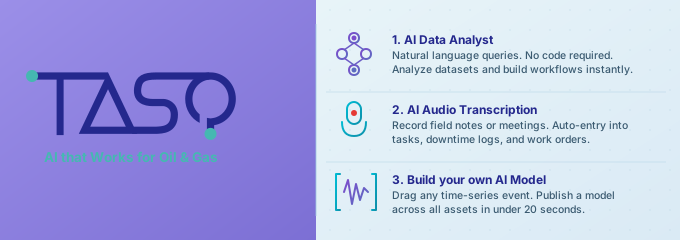
At the core of Tasq 5.0 is simplicity and speed. By embedding search, analysis, model building, workflows, and data entry into one unified system, we turned what used to take hours into a 10 second process. Users can now create their own AI workflows effortlessly, driving value across the organization without relying on complex setups or bottlenecks.
Empowering Users with AI
Traditional AI tools required specialized knowledge to build and deploy models. But in oil and gas, the real experts are domain specialists, not Python programmers. Tasq 5.0 empowers users to create, deploy, and refine AI models instantly, leveraging their deep industry knowledge without needing coding skills.
Tasq 5.0 does not just digitize workflows; it transforms them. It automates data capture, improves processes, and proactively addresses issues before they escalate.
The Future of Transformation
With Tasq 5.0, we have built something that delivers real transformation. Not buzzwords, but true impact. Instant, powerful, and noticeable. By focusing on simplicity, intelligence, and integration, we have created a tool that works across any time series and any department, empowering users to solve their problems faster and smarter.
Tasq 5.0 is not just another product update. It is a rethinking of how software should work in oil and gas.