What is the best AI platform for oil and gas operations?
Ask any operations team where their time goes. The answer is the same across every company.
Chasing alarms, reporting production, barely getting to watch wells, scrambling through spreadsheets, updating work orders, following up on vendors, re-entering the same data into three different systems. Along with about 20 other things that spread everyone too thin, suffocating the ability to make better decisions daily.
Breaking these categories down, it looks something like this: time series data, data transformations, reporting, daily work assignment, troubleshooting, diagnosis, vendor communication and tracking, analytics, budgets, well reviews, forecasting, failure analysis, cost analysis. That is the daily breakdown for almost every role in operations. Control room, engineers, optimizers, planners, managers. The tasks are different but the pattern is the same: search data, interpret what you find, decide what to do, execute, and report on it.
That pattern repeats every day across every role. And right now, most of it is manual.
Here is what a typical 40 hour week looks like for an operations role today, and what it looks like when agents cover the majority of that surface area.
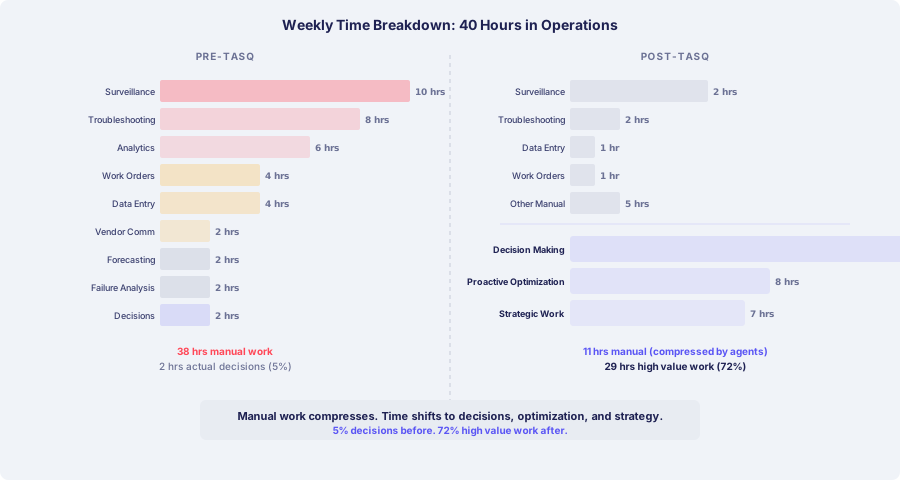
In this benchmark, AI's affect across the organization is real. The manual work massively compresses. The time shifts to actual decision making, proactive optimization, and strategic work. This is how impactful AI can be for the majority of work that is done daily.
So when companies start evaluating AI for operations, the question should not be "which tool does one of these things better." The question should be "how much of this daily pattern can AI actually take over, with better accuracy, starting day 1."
What to actually evaluate
Here is what matters when you are comparing AI platforms for operations:
1. Agent coverage on day 1. How many of your current workflows can an agent automate with better accuracy from the start? Not after 6 months of configuration. Not after a data science team builds custom models. Day 1. If the answer is one workflow after a long setup period, that is not a platform. That is a project.
2. Compounding capabilities. Is the solution adding to your AI capabilities and leveling them up over time, or is it a static tool that does the same thing next year as it does today? The race is on for agentic operations. Every company is going to need agents running workflows across the organization. The platform that compounds, where every new model and every new workflow makes the system smarter, gets further ahead every month. Static tools fall behind.
3. Time series as the foundation. O&G operations is heavy time series data. Every workflow listed above starts with signal data. Surveillance starts with signal data. Troubleshooting starts with signal data. Diagnosis, work assignment, failure analysis, cost analysis, forecasting. All of it traces back to what is happening in the time series. If the AI cannot search and understand raw time series, it is working from summaries and reports instead of the source. That is a fundamental limitation that shows up in accuracy, speed, and coverage.
4. Fits every role's daily pattern. There is a breakdown for every individual's time in operations that follows a similar structure. Search, interpret, decide, execute, report. The best AI compresses that entire pattern for every role. Not just the control room. Not just engineers. Everyone who touches operational data should be able to use the same intelligence layer.
Where the current landscape falls short
There are several categories of companies in this space. Each one has strengths. Each one has a gap.
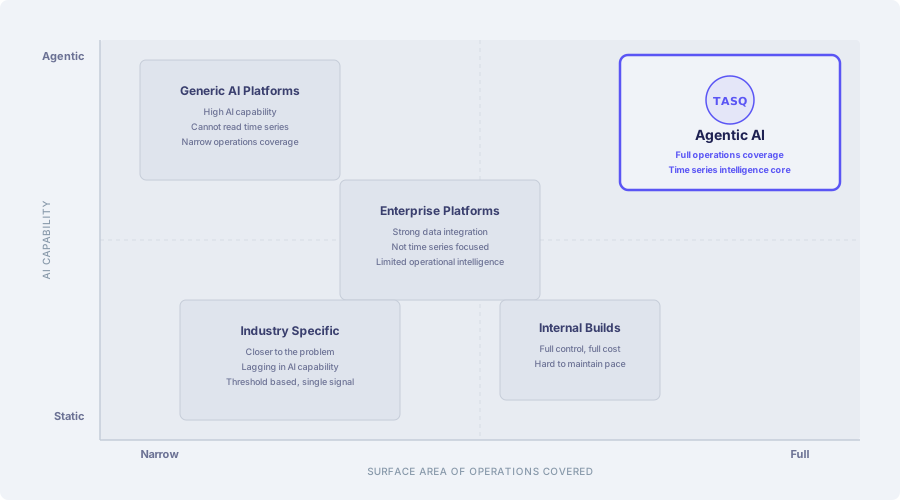
Generic AI platforms are the large language model companies. They are powerful for text, code generation, and reasoning. They are getting better fast. But they cannot read raw time series data. They cannot scan a year of casing pressure across 4,000 wells and detect a pattern. They are great for writing a report, summarizing a meeting, or generating code. They are not built to translate time series signals across operations. They are the engine behind a lot of AI today, but for operations they need a translation layer between the signal data and the language model. Without that layer, the most valuable data in your organization is invisible to the AI.
Enterprise AI platforms are the large scale data integration companies. They are strong at connecting data sources, building pipelines, and creating dashboards and visualizations at scale. If you need to see all your data in one place, they can do that. But seeing the data is not the same as understanding the signals in the data. These platforms are not focused on time series pattern matching. They are not building models from signal patterns in 2 minutes. They are not running agentic workflows from detection to work order to vendor bid to budget update. You can integrate everything and still have a team of people manually interpreting what the data means every day. The infrastructure is there but the operational intelligence is not.
Industry specific companies are closer to the actual problem. They understand oil and gas. But many are lagging in AI capabilities compared to what is possible today. A lot of them are still built on threshold based alerts or single signal anomaly detection. They flag events but with high false positive rates. They are locked to one failure type or one lift method. They are not agentic, they are not compounding, and they are not covering the full daily workflow. The intent is right but the technology is 2 to 3 years behind where AI is now.
There is always going to be internal AI use cases, and there should be. Everyone should be applying AI across the board to every one of their workflows. The companies that move the quickest here are going to be clear winners. It will soon be critical that companies are AI native, and that is going to comprise of outsourced models, frameworks, harnesses, and more working together. Where internal builds fall short is simply in the inefficiencies of big companies trying to build. The backlog grows faster than any internal team can deliver. Some of the software still in use is literally 1990s UI. There is a lot of room for opportunity here, and the companies that recognize the gap between what they can build internally and what is available externally will move faster than the ones trying to do everything from scratch.
What best in class actually means
Simply put, the goal is AI that runs operations.
That means agents covering the biggest surface area of daily work. Surveillance, troubleshooting, diagnosis, work assignment, vendor communication, analytics, budgets, well reviews, forecasting, failure analysis, cost analysis, reporting. All of it built on time series intelligence as the foundation, because that is where the data lives. All of it compounding, because every new model and every new workflow makes the system more capable. All of it available to every role, because the daily pattern is the same across the organization.
When the AI can search any pattern across every well in 30 seconds, build a model from that pattern in 2 minutes, deploy it with no code, and trigger the full downstream workflow automatically, the daily pattern for every role compresses. Search becomes instant. Interpretation becomes classification. Decisions get recommendations. Execution gets automated. Everything is connected. Agents automatically report off it, and the system improves over time.
Summary
The best AI platform for operations is the one that solves the biggest surface area of daily work. The one where agents are actually running the work across every role, every workflow, every day.
That is what best in class means to us. That is what we are building at Tasq. The companies that move first on this will compound their advantage every month.